For more than two decades, SEO was easy: take a keyword; in an article, just write it 10 times and start waiting for rankings. But as the Google Algorithm 2026 continues to change, anyone who has been following that old playbook already surely has noticed traffic decline month over month.
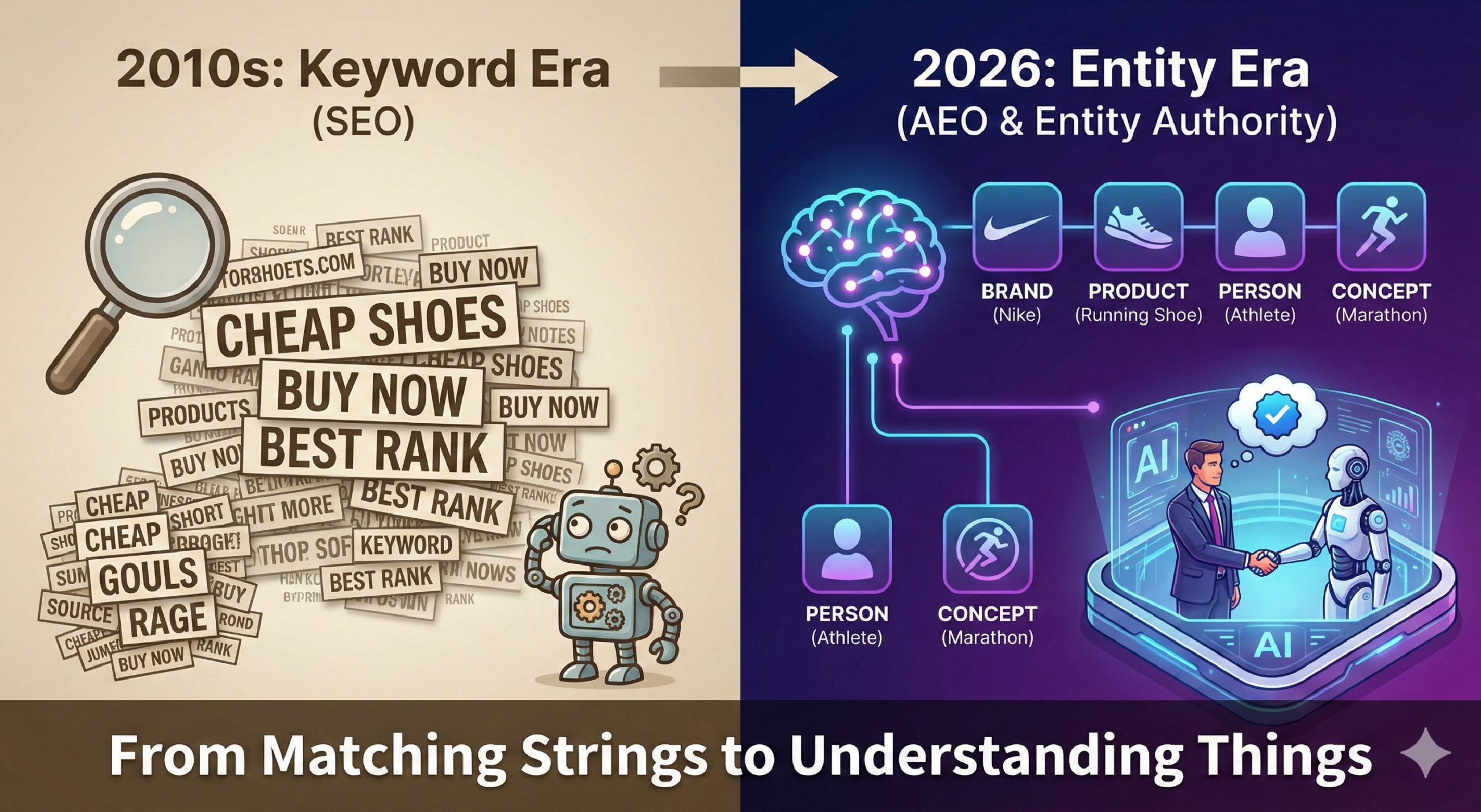
It means that the Google of 2026 has changed. Not just matching text, it understands concepts. It is that shift to from “Strings” to “Things,” and it has fundamentally shifted how we would optimize our search.
Is Google Done With Keywords? The Rise of Entity Authority in Google Algorithm 2026
Here’s why Google no longer cares about your keywords the way it used to, and why Entity Authority is the new ranking factor you need to master.
The Shift: From Keywords to Concepts
In the old days, search engines were just library card catalogs. If you searched for “best running shoes,” Google looked for pages containing that specific string of text.
Today, Google (powered by massive AI models) uses a Knowledge Graph. It doesn’t look for the word “shoes”; it looks for the concept of footwear, manufacturers, athletes, and reviews.
- Keywords are just the input (what users type).
- Entities are the output (what Google understands).
If Google doesn’t understand the Entity behind your content (Who are you? What is your brand? Are you an expert?), no amount of keywords will save you.
What is an Entity SEO?
An entity is anything that is singular, unique, well-defined, and distinguishable.
- Examples: A person (Elon Musk), a place (Sri Lanka), a thing (iPhone 16), or a concept (Search Engine Optimization).
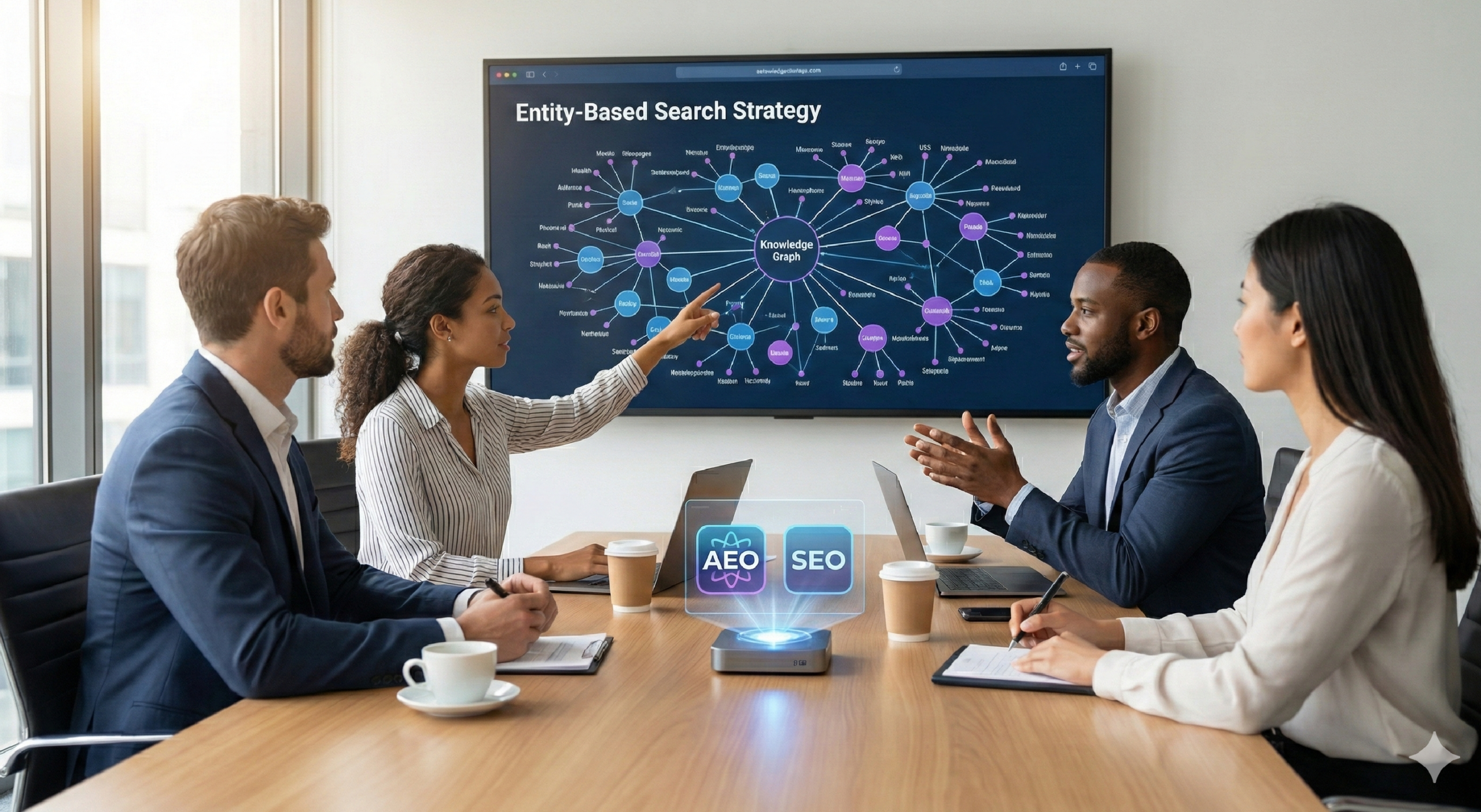
Google maps these entities in a web of relationships. It knows that “Barack Obama” (Entity A) was the “President” (Relationship) of the “USA” (Entity B).
The New Algorithm: Entity Authority
In the era of AEO (Answer Engine Optimization), Google and AI chatbots need to verify facts before they serve answers. They do this by measuring Entity Authority.
Google evaluates your website based on three main “Entity” signals:
1. Identity (Who are you?)
Can Google clearly distinguish you from others?
- The Test: If someone searches your brand name, does a Knowledge Panel appear on the right side? If not, to Google, you might not exist yet.
- The Fix: Use Schema Markup (Structured Data) to explicitly tell Google, “We are an Organization, focused on Marketing, located here.”
2. Relatedness (Do you belong here?)
Google looks at the relationship between your Entity and the Topic.
- Low Authority: A generic news site writing about medical advice. (Weak relationship).
- High Authority: A certified dermatologist writing about skincare. (Strong relationship).
- The Fix: Stick to your niche. Build “Topical Authority” by covering every angle of your specific industry rather than chasing trending keywords outside your expertise.
3. Corroboration (Do others agree?)
Backlinks still matter, but “Mentions” matter more. Google looks for validation of your entity on trusted 3rd-party nodes in the Knowledge Graph.
- The Fix: Get cited in industry journals, Wikipedia, published books, or authoritative directories. Google trusts what others say about your entity more than what you say about yourself.
The Verdict: Do Keywords Still Matter?
Yes, but their role has changed.
Keywords are now just the bridge to help users find your Entity. You still need them to signal relevance, but Entity Authority is what signals trust.
In 2026, you cannot rank by “tricking” the algorithm with keyword density. You rank by becoming the entity that is the authority on the topic.
My Experience Beyond Keyword SEO
In my role as an SEO and AEO expert, I have noticed the new Google priorities—and the keyword is not the center anymore. Today, Google doesn’t care as much about the words you repeat but more about the meaning and value you signify. Entity AuthorRank has replaced the obsession with keywords. Google now comprehends people and brands and relations among them. For me as a content developer, the goal involves signifying my expertise and significance. Instead of targeting the keyword and its repetition, try to serve the user. Google will relate you as an important resource to be trusted if your site has the capacity to provide enough information and recognition on the internet.
✅ Quick Summary Checklist for 2026 SEO
- Stop writing content just to hit a word count.
- Start building a “Content Cluster” around a single topic to prove expertise.
- Stop obsessing over keyword density.
- Start implementing Organization and Author Schema on every page.
- Stop building spammy backlinks.
- Start building a real brand (Entity) that people search for by name.
You Might Also Like