If you are still anxiously checking keyword density tools in anticipation of 2026, we have some tough news: you are optimizing for a version of the internet that no longer exists, one where keywords outweighed Entity Authority.
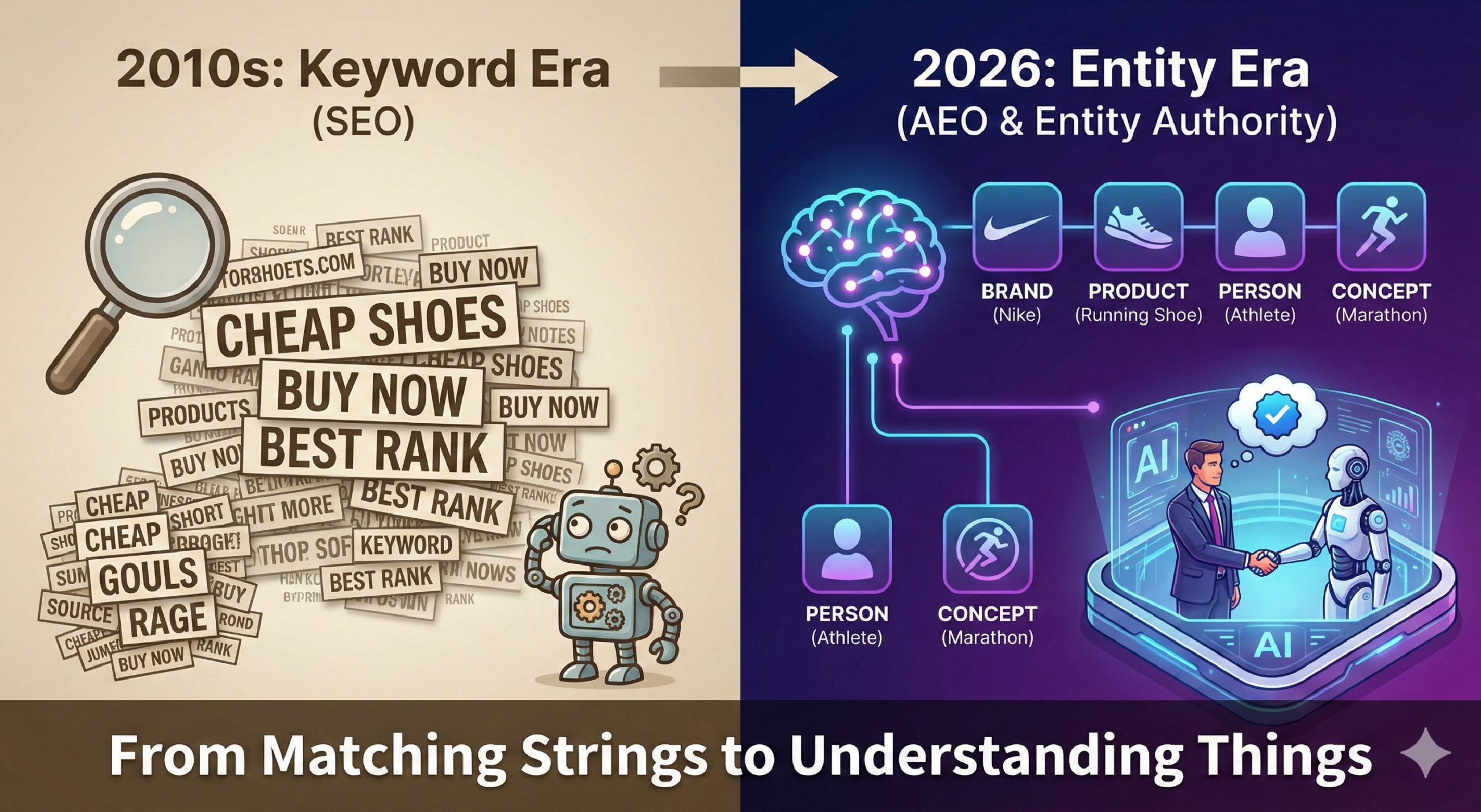
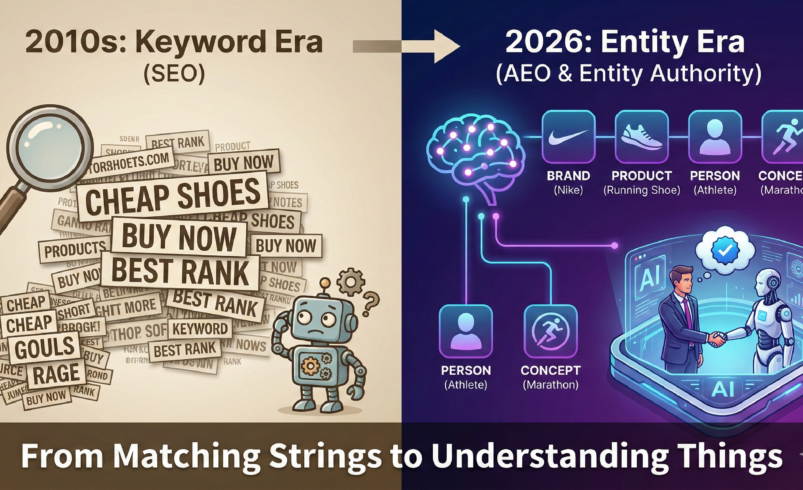
Take a look at where search is heading. Everything’s shifting. The old days were all about matching up text “strings.” Now, search engines are getting smarter—they don’t just see words, they actually understand real-world “things.”
So, keyword optimization? That chapter’s closing. The new game is Entity Authority. And if you want to win at AEO (Answer Engine Optimization), you need to rethink your entire strategy.
Strings vs. Things: How Search Changed
To understand the future, we have to look at how search engines have evolved.
The Old Way (Keywords = Strings):
Let’s rewind. For years, search engines played a pretty simple game. You typed in “best vegan pizza recipe,” and the algorithm just hunted for pages with those exact words. SEO experts would sprinkle those keywords in titles, headlines, body text—anywhere they could—to prove they were relevant.
The New Way (Entities = Things):
But that’s history. Thanks to AI and massive models like Gemini, search engines aren’t just scanning for words anymore. They’re making sense of Entities. An entity can be a person, a company, an idea, a product—basically, anything specific and identifiable.
So, Google’s Knowledge Graph isn’t confused. It knows “Pizza” is a food. “Vegan” is a diet. “Domino’s” is a company that sells food. It’s not just matching random words; it’s connecting the dots.
By 2026, search engines won’t care if you repeat a keyword a hundred times. They care about you—who you are as an entity, and how much authority you have on the topic someone’s searching for.

Why AI Left Keywords Behind
Why did we get here? Simple: keywords are easy to fake. Anyone can toss a few buzzwords on a website and claim to be a “leading crypto expert.” But that doesn’t make it true.
AI-powered search, or AEO, has to deliver real answers—right there on the results page. For AI to trust an answer, it needs to trust the source, not just the words. It’s looking for entities with real, proven credibility in a topic area.
If Google’s AI doesn’t recognize your brand—not as just a bunch of web pages, but as a real “Thing” in its Knowledge Graph—you’ll be invisible in the search results of 2026.
So, What’s “Entity Authority” Anyway?
Think of Entity Authority as the reputation score the search engine gives your brand or author on a certain topic.
Here’s the difference:
- Website A writing an article about heart surgery.
- The Mayo Clinic (a recognized Medical Entity) writing an article about heart surgery.
Even if Website A is stuffed with the “right” keywords, the AI is always going to pick the Mayo Clinic. Their authority as a medical entity is bulletproof.
In 2026, that’s what really matters. Not keyword tricks. Not density calculators. Real credibility, built around who you are and what you know.
The Roadmap: How to Build Real Entity Authority in 2026
So, how do you break free from the keyword-chasing hamster wheel and actually build Entity Authority? Modern SEO isn’t about stuffing your site with random topics anymore. You need to double down on a few key areas:
1. Pick Your Niche and Own It
Remember when you could write about anything and still rank? Those days are gone. In 2026, AI wants depth, not breadth. If you want authority, you have to lock in on a tight topic cluster.
Don’t try to be a jack-of-all-trades. Forget about being a “lifestyle blog.” Instead, go all-in on a clear subject—like “Urban Sustainable Gardening.” The sharper your focus, the faster you become the go-to source.
2. Schema Markup: Speak Machine
Structured data isn’t just a nice-to-have anymore—it’s your way of talking directly to search engines.
People read your “About Us” page to figure out who you are. Machines read your Schema. Make it clear: use Organization and Person schema to tell Google, “Hey, this is who we are, this is who founded us, and this is what we specialize in.”
Don’t stop there. Add sameAs markup to link your site with your profiles on LinkedIn, Crunchbase, Wikipedia—wherever you have a presence. This clears up any confusion about who you are and sets you apart from others with similar names.
3. E-E-A-T: It’s About the People
Google doesn’t care about anonymous blog posts. E-E-A-T (Experience, Expertise, Authoritativeness, Trustworthiness) is all about the people behind the words.
So, who’s actually writing your content? Are they a real, recognized expert in your space? In 2026, you can’t hide behind an admin login. Your authors need verifiable reputations—think LinkedIn, published work, citations on authoritative sites—and you need to connect those dots for Google.
4. Get Noticed by the Right People
Backlinks still matter, but plain links aren’t enough. What really builds your entity is getting mentioned by other authorities.
A random directory link won’t move the needle. But if a respected name in your industry—like a top news site or a major influencer—mentions your brand in the context of your subject (even if there’s no link), it boosts your standing in the Knowledge Graph.

Conclusion
The big shift from 2025 to 2026? Some SEOs will keep clinging to keyword sheets. The smart ones will build digital reputations and become the trusted answer for their topic.
Stop treating your website like a bunch of pages fighting for clicks. Start building a brand that stands out as the Entity worth trusting. That’s the way forward in search.
You Might Also Like